
CURE [1] erases a concept, such as a painter's style, from a text-to-image diffusion model with one closed-form edit to the cross-attention key and value weights. No training. The problem is erasing more than one. Erase concepts one after another and the edits don't compose cleanly: each pair leaves a cross term that damages images you never meant to touch. CURE-Improve is a small team research codebase built around one fix, CURE-Sequential. It keeps a bank of every direction already erased and forces each new concept's projector to be orthogonal to all of them, which makes the cross term zero by construction.
On Stable Diffusion v1.4 [2], with 3 seeds at 384 px, the bank helps up to a point. From 5 to 50 erased artists, CURE-Sequential drifts less on artists it was never asked to erase (LPIPSu 0.7375 against 0.7735 at k=5, CLIPu up 0.64 to 2.23 points). At 100 erasures it flips and is worse on both measures (LPIPSu 0.7939 against 0.7680, CLIPu 21.25 against 21.69). That lines up with the idea's one real cost. CLIP's text space has 768 dimensions, and every erased concept spends some of them for good.
Why It Matters
Concept erasure is for the case where a model has to stop producing something. CURE erases a concept in about two seconds with no gradient steps, which makes it attractive for the "erase a hundred artists" setting. That is also where it degrades. The CURE paper's Figure 6 shows perceptual divergence starting around 50 erasures and stronger interference on untargeted prompts beyond about 100. The question for this project was whether that failure can be fixed without training anything.
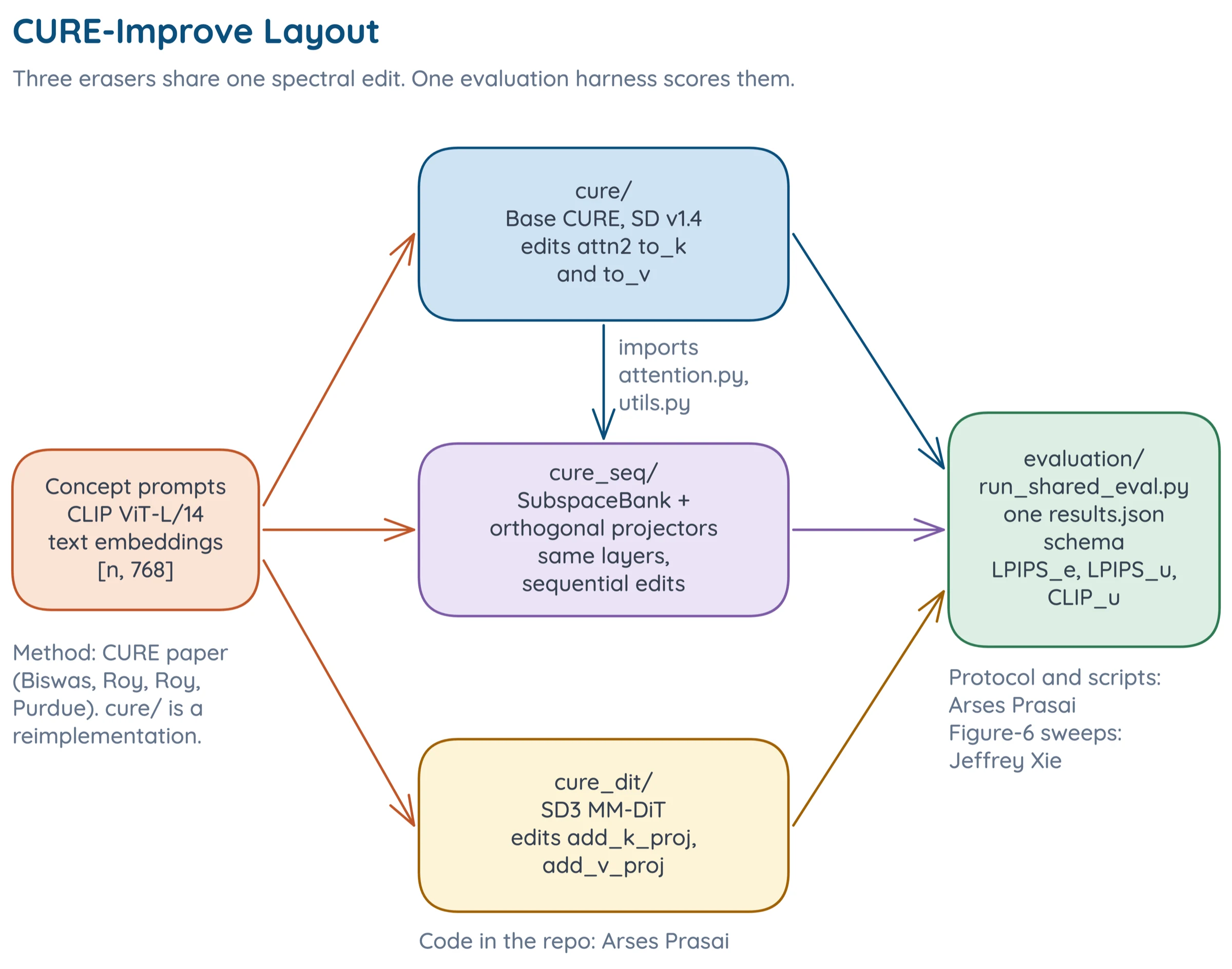
The work was split. Arses Prasai built the implementation, which includes a reimplementation of CURE for SD v1.4 (not the authors' code), the sequential variant, a port of the same idea to SD3's MM-DiT architecture, and a shared evaluation harness that scores every method the same way. He also ran the quick-proof benchmark. Jeffrey Xie ran the Figure-6-style sweeps behind the main results. My part is the analysis of the method gaps and a synthetic check of the linear algebra.
Technical Details
The CURE Edit
Take the text encoder's embeddings of prompts describing the concept, a matrix
The function
Why Sequential Edits Interfere
Erase concept 1, then concept 2, with the same recipe.
The first three terms are what you wanted, one projector removed per concept, but the last term,
Orthogonalizing Against a Bank
If each new concept's basis is first projected off everything already erased, the subspaces are mutually orthogonal and the cross term is exactly zero for the forget projectors, since
then re-orthonormalize with QR and append.
The price is a finite budget. Every concept spends dimensions no later concept can use, and CLIP's embedding space has only 768 of them. The guarantee is also scoped to the forget subspaces. The retain projector
How the Pieces Fit Together
The base eraser holds the attention utilities that find and edit the attn2 layers. CURE-Sequential imports those utilities and adds the SubspaceBank, a spectral module that computes orthogonalized projectors, and a SequentialCURE class. CURE-DiT reuses the spectral idea for SD3. The evaluation harness runs any of them under one config and one results schema and computes the Figure-6 metrics. By line count that is about 2,100 lines for the base method, 1,300 for CURE-Sequential including experiments, 650 for CURE-DiT and 2,900 for evaluation.
The DiT Port
SD3 has no cross-attention. Text and image tokens attend jointly, and the text stream has its own key and value projections. cure_dit applies the same edit to those, add_k_proj and add_v_proj, in each joint transformer block, in a 1152-dimensional context space, in float32 before casting back [4]. All the results below are on SD v1.4.
The Metrics
The evaluation computes three numbers per checkpoint. LPIPSe [5] is the perceptual distance from the unedited model on erased artists, and higher means stronger removal. LPIPSu is the same distance on unerased artists, and lower means less collateral damage. CLIPu [6] is text-image alignment on unerased prompts, and higher is better. All three methods go through the same evaluation and output schema, so every comparison below is like for like.
Implementation
All code excerpts below are Arses's.
The Weight Edit
The edit itself is two matrix products per attention layer, applied to the key and value projections.
# cure/attention.py |
The layers come from walking the SD v1.4 UNet's down, mid and up blocks for every transformer block's attn2, the cross-attention where image tokens attend to the 768-dimensional text embedding.
The Subspace Bank
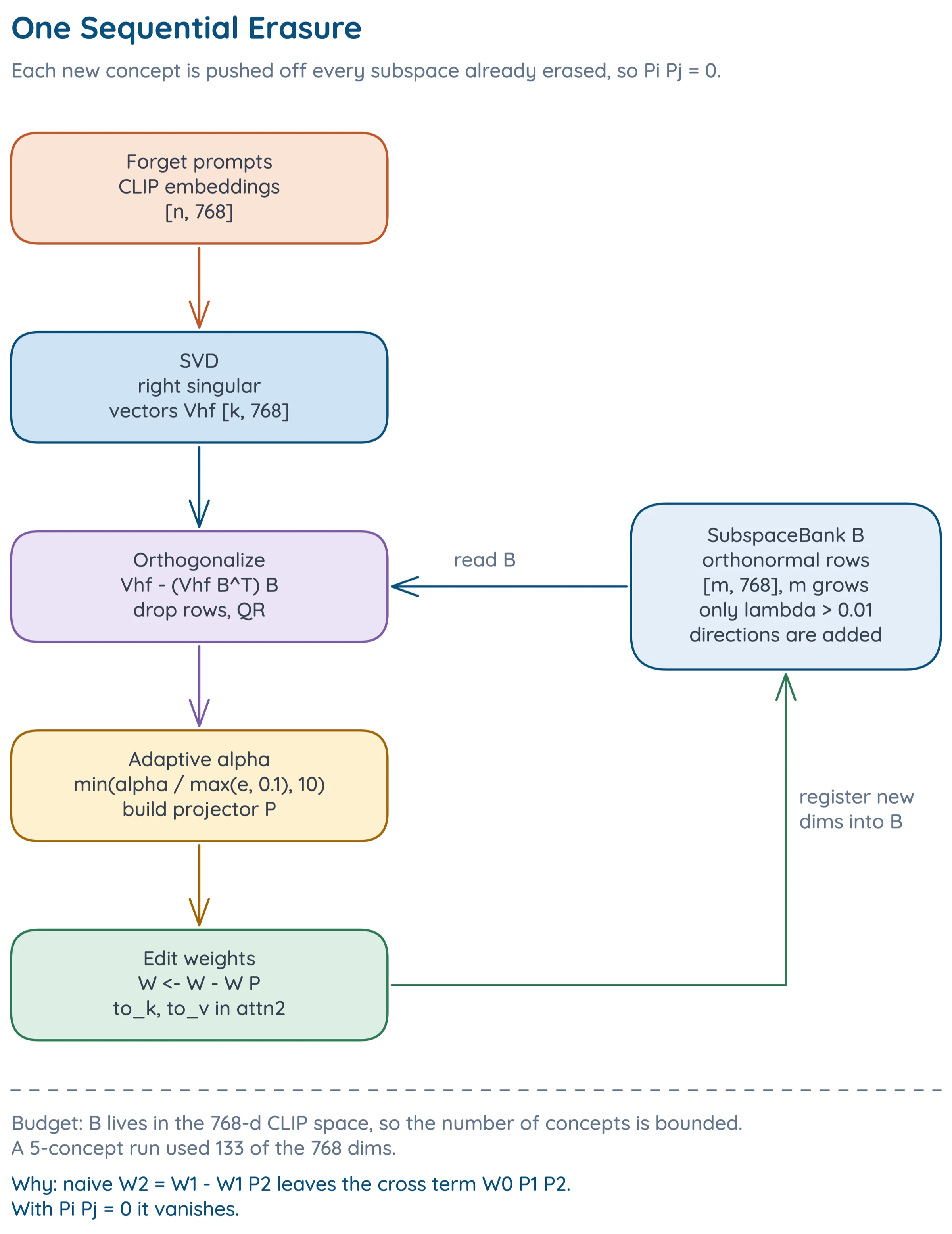
The core operation is a projection off the bank, a drop of rows the bank has already consumed, and a QR re-orthonormalization.
# cure_seq/subspace_bank.py |
Registering a concept does not add all of its directions. Only directions whose spectral weight exceeds 0.01 go into the bank (problem 2 is why).
Adaptive Alpha
Orthogonalizing removes some of a concept's energy, because part of it lived in directions earlier concepts already own. To compensate, the spectral expansion parameter is boosted in proportion to the energy lost.
# cure_seq/spectral.py |
Problems
1. Cross Terms Accumulate With Every Erasure
The derivation above is the reason the project exists. Plain sequential CURE leaves a
2. One Concept Can Consume the Whole Space
A concept described by 20 prompts at 77 tokens each yields 1,540 embedding samples, which span all 768 dimensions. Register every direction and the first concept exhausts the bank. The fix is to register only directions with spectral weight above 0.01, which leaves roughly 20 to 40 directions per concept. The 5-concept demo used 133 of 768 dimensions (17.3%), about 27 per concept, at about 0.25 seconds per concept.
3. Orthogonality Has a Budget
At 20 to 40 directions per concept, the bank holds roughly 20 to 40 concepts before the budget tightens. That is well under the 100 erasures of the largest experiment. It is also why the k=100 result below is the interesting one. Past the budget, later concepts get less and less room of their own.
4. Orthogonalizing Weakens the Edit
Projecting a concept off the bank throws away whatever energy it shared with earlier concepts, so a late concept is erased more weakly than an early one. Adaptive alpha compensates by boosting the spectral expansion by the inverse of the energy retained, capped at 10. That keeps late erasures strong, but it also pushes a stronger edit through a smaller subspace, which is one of the two explanations for the k=100 reversal.
Experiments
There are three experiments.
- Figure-6-style sweeps (Jeffrey Xie). SD v1.4, CURE against CURE-Sequential, seeds 11, 22 and 33, 20 sampling steps, guidance 7.5, 384 by 384 pixels, alpha 2.0, Tikhonov spectral mode, masked-mean embeddings. A 50-artist run with checkpoints at k = 1, 5, 10, 25, 50, and a 100-artist extension adding k = 100. The k = 1 to 50 checkpoints match between the two runs.
- Quick-proof benchmark (Arses Prasai). Nine unique runs using a fast CLIP-based proxy with a "target" score (lower means better suppression) and a "drop" score (lower means better retention).
- A synthetic orthogonality check (mine). Random low-rank concepts in 768 dimensions with no model in the loop. It tests only the linear algebra.
This is a fast setting, not a full benchmark. Three seeds, 20 steps and 384 pixels keep the sweeps cheap, and LPIPS at this scale is a proxy for what a user would call damage. Standard deviations are about 0.06 to 0.10 for LPIPSu (the largest, 0.098, is CURE-Sequential at k=100) and about 3 for CLIPu.
Results
Sequential Erasure on 50 and 100 Artists
Differences, CURE-Sequential minus CURE, from Jeffrey's sweeps.
| k | dLPIPSu (lower is better) | dCLIPu (higher is better) | dLPIPSe |
|---|---|---|---|
| 1 | +0.0000 | +0.000 | +0.0000 |
| 5 | -0.0360 | +1.392 | -0.0160 |
| 10 | -0.0304 | +2.232 | -0.0265 |
| 25 | -0.0244 | +1.036 | -0.0090 |
| 50 | -0.0142 | +0.641 | -0.0292 |
| 100 | +0.0260 | -0.439 | +0.0019 |
At k=1 the two methods are identical, as they must be, because the bank is empty. From k=5 to k=50, CURE-Sequential has lower LPIPSu and higher CLIPu at every checkpoint, but the LPIPSu advantage shrinks steadily, from 0.036 to 0.014. It is also less aggressive on the erased artists, with a lower LPIPSe at each of those checkpoints, which is the "more surgical" behavior the bank was designed for. At k=100 the sign flips on both preservation metrics, and CURE-Sequential's LPIPSu spread (0.098) is wider than CURE's (0.079).
LPIPSu is already 0.709 at k=1 for both methods, so the baseline drift from a single erasure is large in absolute terms. The method gaps of 0.014 to 0.036 are smaller than or comparable to the LPIPSu standard deviations, and the CLIPu gaps of 0.6 to 2.2 sit against a standard deviation of about 3. What holds up is the direction, which is the same at all four checkpoints from k=5 to k=50.
The k=100 reversal fits the budget story, since 100 concepts is far past the 20-to-40 estimate. The other candidate is adaptive alpha pushing a strong edit through a shrinking subspace (problem 4), and the sweeps don't separate the two.
Quick-Proof Benchmark
Across the nine runs, the picture is mixed. CURE-Sequential wins on both target and drop in the five Gavish-Donoho forward runs. Four of those are the same run in effect. The 20-concept forward runs at alpha 1.5, 2.0, 2.5 and 3.0 give identical numbers (target 26.7340 for CURE and 24.8841 for CURE-Sequential in all four), because the Gavish-Donoho threshold ignores alpha. In the reverse-order 20-concept Gavish-Donoho run, CURE-Sequential has better retention (drop 1.4540 against 4.2923) and worse suppression (target 26.1652 against 24.3610). In the Tikhonov runs, forward order favors CURE-Sequential on retention, and reverse order gives it slightly better suppression and worse retention (drop 4.7717 against 3.5260). Erasure order matters in the reverse runs. Nine runs of 3 to 5 seeds each don't support more than that.
The Linear Algebra Holds
The synthetic check builds random rank-8 concepts in 768 dimensions with 40 samples each and compares the projectors' pairwise products, with and without the bank, plus the cross term
| Concepts | max off-diagonal |
same, orthogonalized | bank dims used |
|---|---|---|---|
| 2 | 0.0163 | 2.3e-6 | 16 of 768 |
| 40 | 0.0239 | 7.5e-6 | 320 of 768 (41.7%) |
The cross term
What I Would Change
Log the Budget and Rerun k=100
Log the bank's dimension usage at every checkpoint and rerun the 100-artist sweep. Then run it again with adaptive alpha off. That would tell us whether the k=100 reversal is the budget, the adaptive alpha, or noise.
Test the Retain Path
The zero-cross-term guarantee holds by construction for forget projectors only. A synthetic test with retain prompts, using the same harness as the orthogonality check, would show how large the residual cross term is when
Report the Noise Alongside the Means
Report paired differences per seed and prompt with a confidence interval. A paired comparison would pin down how large CURE-Sequential's advantage at k=5 to 50 is.
Measure Erasure Directly
LPIPS and CLIP score drift and alignment, not whether the artist is actually gone. A classifier or a round of human ratings on the erased artists would check the removal side, which the current metrics only approximate.
References
- Shristi Das Biswas, Arani Roy, Kaushik Roy. CURE: Concept Unlearning via Orthogonal Representation Editing in Diffusion Models. arXiv, 2025. arXiv:2505.12677
- Robin Rombach, Andreas Blattmann, Dominik Lorenz, Patrick Esser, Björn Ommer. High-Resolution Image Synthesis with Latent Diffusion Models. CVPR, 2022. arXiv:2112.10752
- Matan Gavish, David L. Donoho. The Optimal Hard Threshold for Singular Values is 4/sqrt(3). IEEE Transactions on Information Theory, 2014. arXiv:1305.5870
- Patrick Esser et al. Scaling Rectified Flow Transformers for High-Resolution Image Synthesis. ICML, 2024. arXiv:2403.03206
- Richard Zhang, Phillip Isola, Alexei A. Efros, Eli Shechtman, Oliver Wang. The Unreasonable Effectiveness of Deep Features as a Perceptual Metric. CVPR, 2018. arXiv:1801.03924
- Alec Radford et al. Learning Transferable Visual Models From Natural Language Supervision. ICML, 2021. arXiv:2103.00020