
A bank's fraud desk can't read every card transaction by hand, and running an LLM on every transaction is too slow and too expensive. Aegis is the funnel I built for that problem at TartanHacks, CMU's hackathon, in February 2026, with my teammate Jalen Francis. Transactions stream through a Redpanda (Kafka) topic. A cheap gate, a scikit-learn Isolation Forest [1] plus hand-written rules, scores each one. Anything above 0.55 becomes an alert, and a pool of three asyncio workers hands each alert to a ReAct-style agent [2] on a local Ollama model, which answers BLOCK, CLEAR or FLAG_FOR_REVIEW. Flagged alerts wait for a human, and every verdict goes into a FAISS index [3] that later investigations can search.
The whole design rests on the gate, so I measured it on 5,000 synthetic transactions per run over 6 runs. It sent 2.9 to 3.2 percent of traffic to the agent with precision 1.000 in every run, so not one normal transaction reached the LLM. Recall was 0.368 to 0.403, and it splits cleanly by amount. In a 3,000-transaction run every fraud above $1,000 was caught, so the gate's recall is the share of fraud above that line.
Why It Matters
The hackathon theme was to make a bank's fraud desk faster. The shape that fits is a funnel, where something fast and cheap looks at everything and something slow and smart looks only at what the fast stage flags. The whole system lives or dies on that first stage. Here is what Jalen and I built in roughly 20 hours. I wrote the backend and the React dashboard, and Jalen did the design, the demo and the slides.
- A stream of card transactions arriving through Kafka, the way a bank's would.
- A fast first stage that scores every transaction and lets most of them through.
- A slow second stage, an LLM agent with tools, that investigates only what the first stage flags and returns a verdict with a written reason.
- A human review queue for the verdicts the agent isn't sure about, with Slack notifications.
- A memory, so that a human decision today informs a similar investigation tomorrow.
- A live dashboard over WebSockets.
- A separate dispute-resolution agent, a Neo4j fraud-ring graph and a Redis cache as extras.
Technical Details
Isolation Forest as a First Stage
An Isolation Forest [1] builds random trees that split a randomly chosen feature at a random value. A point far from the rest gets separated in only a few splits, so its average path length is short, and the model turns that into an anomaly score. It needs no labels, which suits fraud, where labels arrive late. In scikit-learn, decision_function returns a negative value for points the model considers outliers and a positive value for inliers [4]. Aegis maps that raw value onto a 0 to 1 risk score.
Gating an Expensive Stage
If the second stage costs seconds and the first costs milliseconds, the first stage decides how much work the second sees. Two numbers matter. Precision at the gate sets how much of the LLM's time goes to innocent transactions. Recall at the gate caps the whole system, because a fraud the gate lets through is never investigated by anything downstream. Those are the two numbers I measured.
ReAct Without Native Tool Calling
ReAct [2] interleaves reasoning text with tool calls. The model writes a thought and names an action, and the harness runs the action and appends the observation. The prompt-based form has the model emit Thought, Action and Action Input as plain text, which the harness parses. That form is easy to build and sensitive to how well a small model follows a format.
Retrieval as Memory
A sentence embedding maps text to a vector where similar meanings sit close together. FAISS [3] stores those vectors and returns nearest neighbors. With L2-normalized vectors, inner product equals cosine similarity, so an IndexFlatIP gives exact cosine top-k. Storing past verdicts as text and retrieving the nearest ones into the agent's prompt gives the agent a memory of what was decided before. The memory is pure retrieval, and nothing about the model or the gate changes.
Architecture
The producer, consumer and workers all run as background asyncio tasks inside one FastAPI process. Redpanda, Neo4j and Redis run as containers beside it, and Ollama runs on the host.
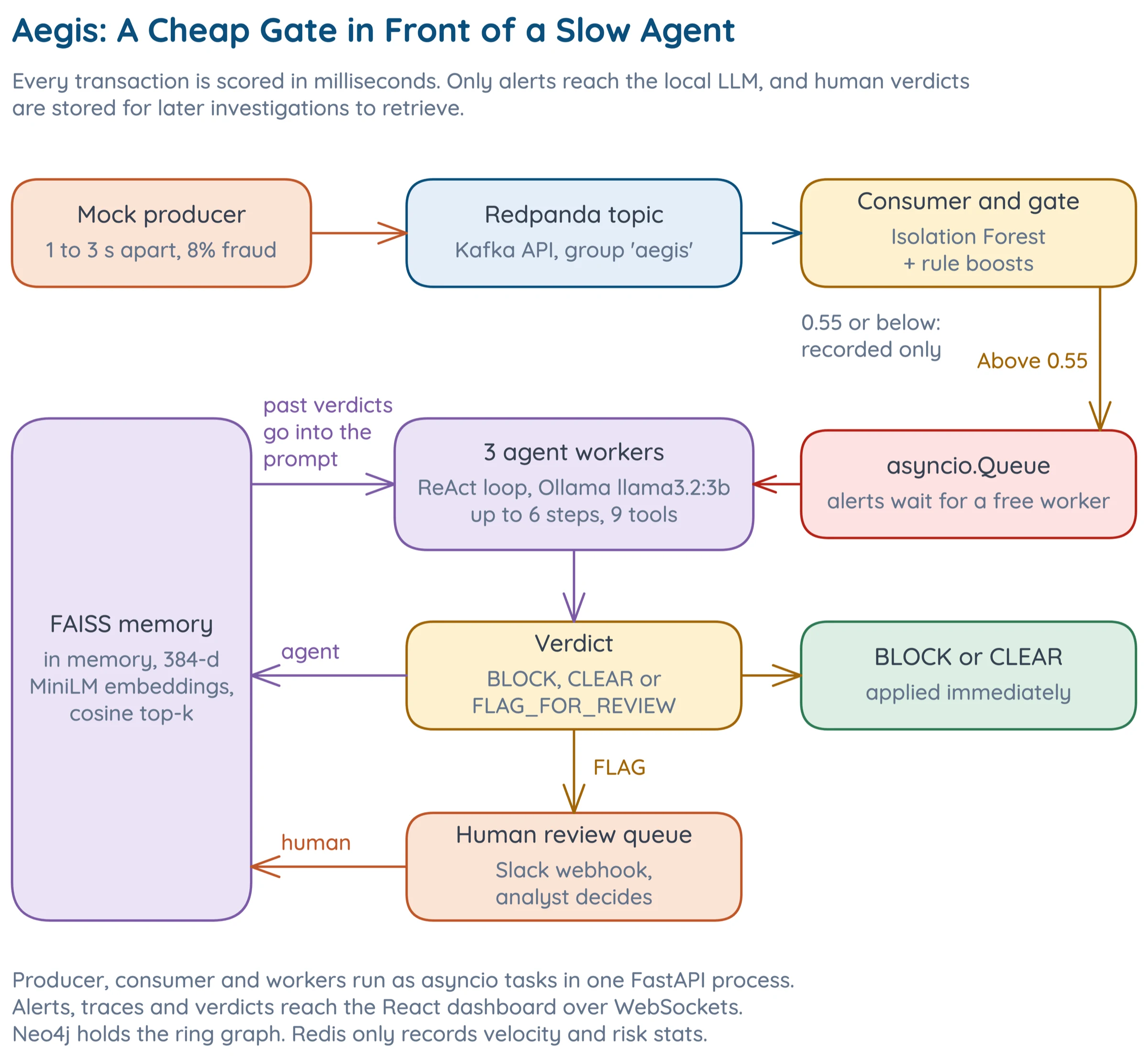
A transaction goes producer, topic, consumer, gate. Most stop there. About 3 percent cross 0.55 and go onto a plain asyncio.Queue, where three identical workers pull them and run the agent. The verdict either applies immediately (BLOCK and CLEAR) or waits for a human (FLAG_FOR_REVIEW). Both agent and human verdicts are embedded into FAISS, and the agent has a tool that queries it.
Implementation
The Features and the Forest
The forest trains at startup on 1,000 synthetic "normal" rows. There are 8 features: amount, log of amount, hour, day of week, whether the country isn't US, velocity (transactions in the last 10 minutes), distance in kilometers from the account's last transaction, and the account's amount z-score. Velocity, distance and z-score come from an in-process per-account tracker that keeps the last 100 transactions per account.
self.model = IsolationForest( |
From Raw Score to Flag
This is a simplified version of detect(), not verbatim. The forest's output is scaled to 0 to 1 with a small Gaussian jitter, and then rules for foreign merchants, large amounts and risky categories raise the score.
raw_score = self.model.decision_function(features)[0] |
A non-US transaction above $1,000 always lands between 0.60 and 0.80, so it always becomes an alert. Anything above $5,000 gets a floor of 0.55 to 0.80. A non-US transaction under $1,000 gets a floor of at most 0.40.
The FAISS Novelty Boost
The consumer runs a second check on transactions the gate didn't flag. It's aimed at a small but odd purchase for one specific account, the case the amount and geography rules can't see.
novelty = vector_store.compute_novelty_score(txn_data) |
Novelty is 1 - (0.6 * best_sim + 0.4 * avg_sim) over the same account's past transactions, and it needs at least 5 prior transactions for that account. Each transaction is embedded as a sentence (amount bucket, category, merchant, city, time-of-day bucket, risk score) with all-MiniLM-L6-v2 [5], 384 dimensions, in an IndexFlatIP on normalized vectors.
The Queue and the Workers
Flagged transactions go onto a bare asyncio.Queue(), and the app starts three identical worker tasks.
tasks = [ |
The three workers cap how many LLM investigations run at once, and the queue absorbs bursts.
The Agent Loop
The agent is a manual ReAct loop over ChatOllama at temperature 0.1, with up to 6 steps and a TOOL_MAP of 9 tools: check_account_history, verify_merchant, check_travel_feasibility, get_account_risk_profile, run_kyc_check, find_similar_transactions, find_similar_investigations, detect_fraud_ring and the final recommend_action. The default model is llama3.2:3b. Output is parsed with regexes such as Action:\s*(\w+) and Action Input:\s*({[^}]+}), with fallbacks for malformed output.
Human Review and Memory
A flagged verdict sets the alert to awaiting_review and posts a Slack webhook. blocked and cleared apply immediately. A human decision goes through a review endpoint and is stored in FAISS with verdict_source='human'. Later, the find_similar_investigations tool retrieves the nearest past verdicts into the agent's prompt, so a reviewer's call on one case shows up as context on the next similar one.
Problems
1. Tool Use on a Small Local Model
The agent runs on a local Ollama model, and llama3:8b, the model I started with, had no native tool calling through Ollama. So I stopped asking for structured tool calls and parsed plain text instead. The prompt asks for Thought, Action and Action Input lines, regexes pull out the tool name and its JSON arguments, and fallbacks handle output that doesn't match. A low temperature (0.1) and a hard limit of 6 steps bound how long any investigation runs, and recommend_action is itself a tool, so ending the investigation is just another action the model names.
2. Keeping the LLM Off Most Traffic
Transactions never stop arriving, and each investigation is up to 6 rounds of LLM reasoning and tool calls, so the agent can't look at everything. The gate makes the agent affordable, with one scikit-learn call per transaction, 149 to 153 transactions per second on one thread, and only about 3 percent passed on. Three workers bound how many investigations run at once. The producer, consumer and workers all run as asyncio tasks in one FastAPI process, so investigations overlap without any extra infrastructure.
3. Memory Without Retraining
I wanted a reviewer's decision today to inform a similar investigation tomorrow. I made memory a retrieval problem instead of a training one. Every verdict, the agent's or a human's, is embedded as a sentence and stored in FAISS with its verdict_source, and find_similar_investigations pulls the nearest ones into the agent's prompt. Nothing about the model or the gate changes, so there is no retraining step between a reviewer's call and the next investigation that can use it.
Experiments
I measured the first stage on its own, because it decides what everything downstream sees. The harness runs the gate's scoring engine on a stream that mirrors the producer's mix: about 8 percent fraud (foreign merchants, with amounts drawn the way the producer draws them), 12 percent elevated normal (domestic, 2 to 5 times the category amount) and the rest normal. Each run is 5,000 transactions, over 3 seeds and 2 simulated clock start times (12:00Z and 03:00Z).
Each run records precision, recall, the share of traffic flagged and single-threaded throughput, and a separate 3,000-transaction stream breaks recall down by fraud amount. The traffic and its labels are synthetic, so the numbers describe the gate against the pipeline's own model of fraud, not against real fraud.
Results
The Gate
The full gate had precision 1.000 in all 6 runs, with 0 false positives among 3,959 to 4,011 normal and 600 to 633 elevated normal transactions per run. Recall was 0.368, 0.375 and 0.398 for the noon runs and 0.373, 0.378 and 0.403 for the 03:00 runs. Between 146 and 161 of 5,000 transactions were flagged, which is 2.9 to 3.2 percent of traffic. Hour of day made almost no difference, within about 0.005 recall.
Recall Tracks the $1,000 Line
The gate behaves close to "non-US merchant and amount above $1,000, or amount above $5,000". In the 3,000-transaction run, all 76 fraud transactions between $1,000 and $5,000 and all 8 above $5,000 were flagged. The 78 under $500 and the 71 between $500 and $1,000 went unflagged. The 36.1 percent of injected fraud above $1,000 matched the recall (0.361) in that run, so the recall number is a direct read of where the fraud amounts sit.
Throughput and Load on the Agent
The gate ran at about 149 to 153 transactions per second on one thread, with single-row scikit-learn calls. At the producer's default of one transaction every 1 to 3 seconds, it's nowhere near a bottleneck. As arithmetic, not a measurement: at the default mean of 0.5 transactions per second and about 3 percent flagged, roughly 0.015 alerts arrive per second, about one every 67 seconds, against 3 workers. Under default settings the queue should rarely build, and a backlog would come from bursts such as the demo's fraud injection.
What I Would Change
Label a Small Set With Subtle Fraud
The measurements above use my own fraud generator, so they measure agreement with the pipeline's own model of fraud. A labeled set with small, subtle fraud would turn the sub-$1,000 band into a number someone is trying to raise, and it would give the gate's rules and the novelty check a real target to tune against.
References
- Fei Tony Liu, Kai Ming Ting and Zhi-Hua Zhou. Isolation Forest. IEEE International Conference on Data Mining (ICDM), 2008. doi:10.1109/ICDM.2008.17
- Shunyu Yao, Jeffrey Zhao, Dian Yu et al. ReAct: Synergizing Reasoning and Acting in Language Models. ICLR, 2023. arXiv:2210.03629
- Jeff Johnson, Matthijs Douze and Hervé Jégou. Billion-scale similarity search with GPUs. IEEE Transactions on Big Data 7(3), 2021. arXiv:1702.08734
- Fabian Pedregosa, Gaël Varoquaux, Alexandre Gramfort et al. Scikit-learn: Machine Learning in Python. Journal of Machine Learning Research 12, 2011. link
- Wenhui Wang, Furu Wei, Li Dong et al. MiniLM: Deep Self-Attention Distillation for Task-Agnostic Compression of Pre-Trained Transformers. NeurIPS, 2020. arXiv:2002.10957